
Lock Repair Services in Philadelphia, PA
If your key turns stiffly, your deadbolt will not catch, or your lock suddenly stops working, you may not need a new lock.
Many lock problems in Philadelphia homes and businesses come from mechanical issues that can be diagnosed and repaired on-site. Worn pins, loose hardware, misaligned strike plates, grime buildup, and aging cylinders can often be fixed without replacing the entire lock.
Jefferson Locksmith provides lock repair in Philadelphia Monday through Sunday, from 6 AM to 11 PM.
We dispatch from our Manayunk location at: 128 Leverington Ave Philadelphia, PA 19127
Call (215) 798-4787 and we will send a technician with the parts and tools needed to diagnose the problem properly.
- 20-30 Minutes Response
- No hidden fees
- Licensed & Insured
Our goal is simple:
Fix the lock when it can be fixed. Replace it only when replacement is the better option.
Signs Your Lock Needs Repair, Not Replacement
Most people assume a malfunctioning lock means they need new hardware.
That is not always true.
Many lock failures come from repairable issues inside the lock or around the door frame.
Common signs your lock needs repair include:
- the key turns stiffly
- the key gets stuck in the cylinder
- the deadbolt will not extend fully
- the latch does not catch unless you lift or push the door
- the cylinder feels loose or wobbly
- the lock works sometimes but not consistently
- the deadbolt spins without engaging
- a key broke inside the lock
- the door locks only when pulled a certain way.
Each symptom points to a different possible issue.
A stiff key may mean worn pins or grime inside the cylinder. A deadbolt that will not catch may point to strike plate misalignment. A loose cylinder may be a hardware issue, not a reason to replace the whole lock.
Jefferson Locksmith inspects the lock, door, frame, strike plate, and key before recommending the next step.
If the issue affects more than one lock or you want a broader security review, our residential locksmith service covers full home lock inspections and upgrades.
Types of Lock Repair Jefferson Handles in Philadelphia
Philadelphia has a wide mix of lock hardware.
We repair locks in:
- pre-war rowhomes
- postwar duplexes
- converted apartments
- Fishtown lofts
- South Philadelphia rowhouses
- Center City condos
- commercial storefronts
- office buildings
- rental properties.
The right repair depends on the lock type and the failure point.
Deadbolt Repair
Deadbolts fail for predictable reasons.
The most common causes are:
- worn cylinder pins
- a jammed bolt
- strike plate misalignment
- loose mounting screws
- a broken internal spring
- door frame movement
- grime inside the keyway.
A deadbolt does not always need replacement just because it stops working smoothly.
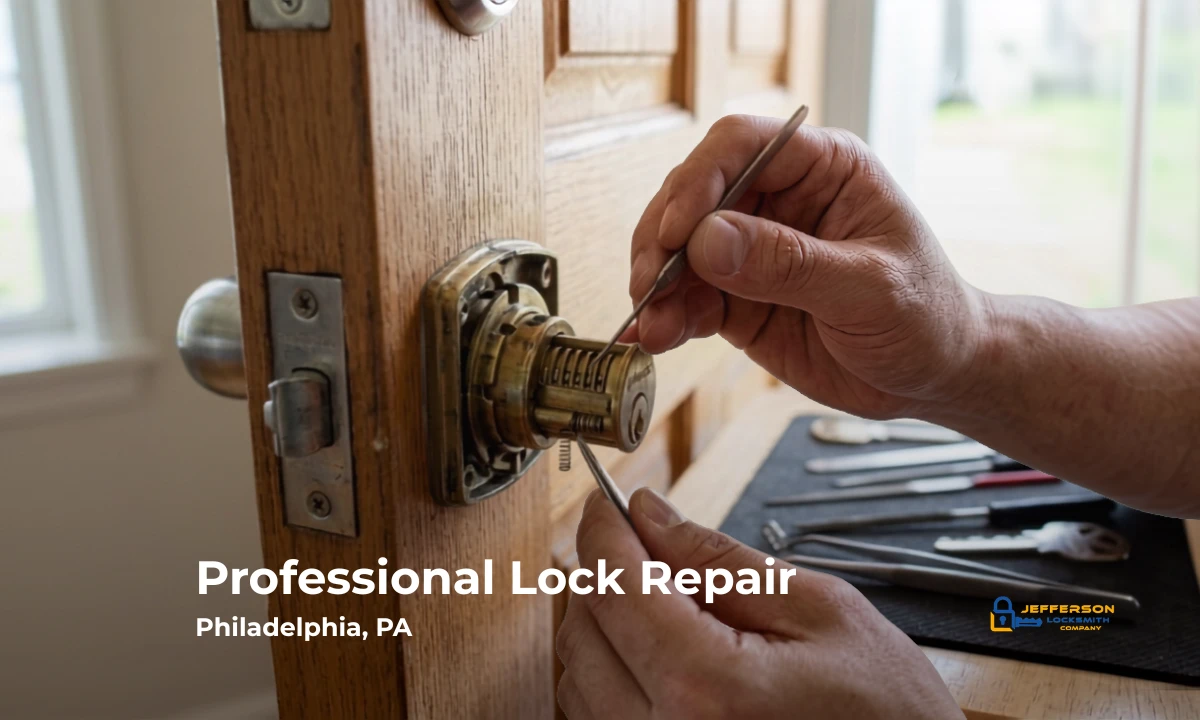
If the cylinder is worn, the technician may service or rekey it. If the bolt is not lining up, the strike plate may need adjustment. If the internal spring or latch mechanism has failed, the damaged component may be replaced.
Jefferson carries common pins, springs, strike plates, and deadbolt hardware on service vans so many deadbolt repairs can be handled in one visit.
Mortise Lock Repair
Older Philadelphia homes often have mortise lock systems.
These are large, multi-component locks installed deep into the edge of the door. They are common in places like:
- Society Hill
- Germantown
- Brewerytown
- Passyunk Avenue rowhomes
- older Manayunk properties
- pre-war homes throughout Northwest Philadelphia.
Mortise locks are durable, but they collect decades of dirt, dried lubricant, worn springs, and internal wear.
Common mortise lock issues include:
- sticking latch bolts
- loose thumb turns
- worn cylinders
- jammed internal springs
- grime inside the lock body
- misalignment between the lock and strike plate.
Many mortise locks are worth repairing because the hardware is often stronger and better built than modern low-grade replacements.
Jefferson technicians inspect the lock body, cylinder, latch, and door alignment before deciding whether repair, rekeying, or replacement makes sense.
Entry Lockset, Knob, and Lever Repair
Knobs and lever handles take daily abuse.
Over time, the internal latch can wear out, the spindle can bend, or the faceplate can loosen from the door edge.
We repair common entry hardware problems such as:
- loose knobs
- sagging levers
- worn latch assemblies
- loose faceplates
- misaligned strike boxes
- handles that turn but do not retract the latch
- doors that close but do not latch securely.
Replacement is only recommended when the housing is cracked, the mechanism is beyond service life, or the hardware no longer secures the door properly.
Broken Key Extraction
A broken key inside a lock does not automatically mean the lock is ruined.
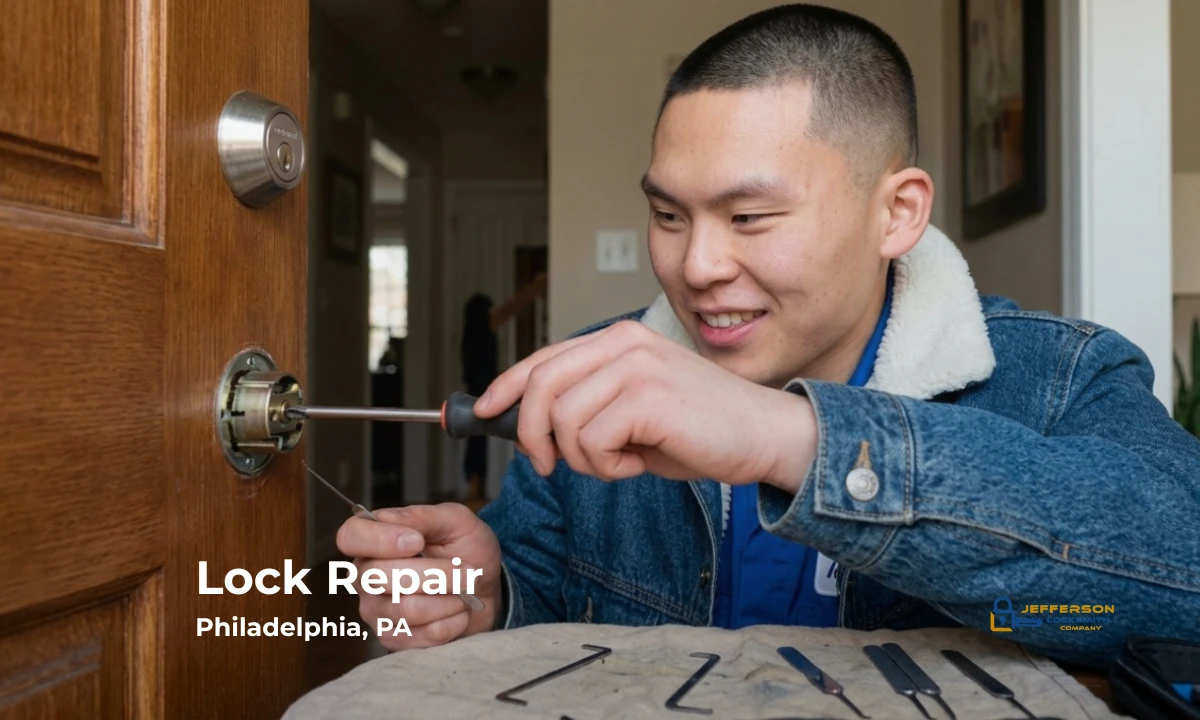
Jefferson Locksmith carries extraction tools designed to remove broken key fragments carefully while avoiding unnecessary damage to the cylinder whenever possible.
After the fragment is removed, the technician checks:
- whether the cylinder still turns smoothly
- whether the key broke because it was worn
- whether the lock is stiff or corroded
- whether a new key should be cut
- whether the cylinder needs repair or rekeying.
If the key broke because the grooves were worn down, cutting a better replacement key may solve the problem.
For more details, see our broken key extraction and key duplication pages.
Post-Break-In Lock Repair
Forced entry can damage more than the lock cylinder.
After a break-in attempt, the technician needs to inspect the entire door assembly.
That may include:
- lock cylinder
- latch bolt
- deadbolt
- strike plate
- strike box
- door jamb
- hinge alignment
- frame damage
- screws and reinforcement plates.
Replacing only the cylinder after a forced-entry attempt may leave the door vulnerable if the frame or strike area was compromised.
Jefferson Locksmith inspects the full assembly and explains whether the lock can be repaired, whether hardware needs replacement, or whether reinforcement is recommended.
For urgent situations after a break-in, see our emergency locksmith page.
Commercial Lock Repair
Commercial locks handle more traffic than residential locks.
They wear faster because employees, customers, vendors, cleaners, and delivery teams may use them throughout the day.
Jefferson repairs commercial lock hardware including:
- storefront locks
- deadbolts
- jimmy-proof locks
- high-security cylinders
- panic bar mechanisms
- office entry locks
- commercial-grade Schlage hardware
- Medeco and Mul-T-Lock cylinders
- mechanical access control components.
If the issue is part of a larger building access problem, our commercial locksmith page covers broader security options.
Why Philadelphia Locks Fail More Often Than You'd Expect
Philadelphia homes put locks under real mechanical stress.
Many rowhouses, twins, and apartment conversions were built decades ago. As foundations shift and door frames settle, the lock and strike plate slowly move out of alignment.
At first, the problem is small.
The door needs a little push.
The key needs a little more force.
The deadbolt catches only if you lift the handle.
Over time, that extra pressure wears down the lock.
Common Philadelphia lock stress points
Older properties often deal with:
- settling door frames
- swelling wood in humid weather
- shrinking or contracting frames in winter
- paint buildup around latch plates
- loose strike plate screws
- worn hinges
- misaligned deadbolts
- corroded cylinders
- old lock hardware that has not been serviced in years.
This is common in Fairmount, Bella Vista, Point Breeze, Germantown, Manayunk, South Philadelphia, and around Temple University, where many doors and frames have been in use for decades.
In many cases, the lock is not failing because it is “bad.” It is failing because the door around it has changed.
A Note About WD-40 and Lock Cylinders
WD-40 is one of the first things homeowners reach for when a lock feels sticky.
It is not always the right solution.
WD-40 can clean out existing lubrication, leave residue inside the cylinder, and attract grime over time. That buildup can make the lock worse later.
When lubrication is actually the right fix, a locksmith may use a graphite-based or PTFE dry lubricant depending on the lock and condition of the cylinder.
If the lock is already full of residue, the better solution may be to clean and service the cylinder rather than keep spraying more product into the keyway.
Repair, Rekey, or Replace: How Jefferson Makes the Call
The right answer is not always repair.
Sometimes the best solution is rekeying. Sometimes replacement is the only responsible recommendation.
Here is the difference:
| Situation | Best Option |
|---|---|
| Lock is mechanically sound but old keys should stop working | Rekey |
| Key turns stiffly because of grime or wear | Repair |
| Deadbolt does not line up with strike plate | Repair |
| Cylinder is loose but hardware is usable | Repair |
| Tenant moved out and key control is the concern | Rekey |
| Lock was damaged in a break-in | Repair or replace |
| Cylinder housing is cracked | Replace |
| Hardware has failed repeatedly | Replace |
| You want a smart lock or higher-security upgrade | Replace or upgrade |
Jefferson explains the options before any work begins.
You decide what to approve. There is no obligation and no pressure.
How the On-Site Estimate Works
Every lock repair call starts with a free on-site inspection.
A phone estimate is not accurate for lock repair because the technician needs to see the lock, the door, the frame, and the hardware condition.
The estimate may depend on:
- lock type
- lock brand
- cylinder condition
- door alignment
- strike plate condition
- whether parts are needed
- whether the lock should be repaired, rekeyed, or replaced
- whether additional hardware is required.
The process is simple:
1. You Call Jefferson Locksmith
Call (215) 798-4787 and describe the symptoms.
We may ask:
- where you are located
- what type of door it is
- whether the key turns
- whether the bolt extends
- whether the lock is loose, jammed, or damaged
- whether the issue followed a break-in attempt.
2. The Technician Inspects the Lock
On-site, the technician checks:
- the lock
- the key
- the cylinder
- the latch or bolt
- the strike plate
- the hinges
- the door frame alignment.
3. You Get a Confirmed Estimate
The technician explains the problem in plain language and provides a confirmed estimate before work begins.
You decide whether to proceed.
4. The Repair Is Completed On-Site When Possible
If you approve the work, the technician completes the repair on-site whenever possible.
Before leaving, the technician tests the lock to confirm:
- smooth key operation
- full bolt extension
- proper latch engagement
- door operation from both sides when applicable
- no unnecessary resistance when locking or unlocking.
Why Philadelphia Homeowners Call Jefferson Locksmith
Jefferson Locksmith is a physical Manayunk business, not a national call center routing jobs to unknown subcontractors. Our technicians operate out of 19127 and know Philadelphia streets.
Steven has worked the city for seven years and understands the hardware quirks that come with older Philly construction: the narrow mortise lock profiles on Society Hill rowhouses, the aging Corbin cylinders on Germantown colonials, the door frame settling common in Brewerytown duplexes.
Jefferson’s management team brings years of experience handling complex security systems and now applies that discipline to residential and commercial security in Philadelphia. That background informs how we assess vulnerabilities and recommend solutions.
Our response is under 30 min. More than 1500 residential jobs completed. +2k positive reviews on Google and Yelp.
Jefferson operates 6 AM to 11 PM, seven days a week. Many locksmiths advertise 24/7 availability, but Philadelphia homeowners have documented in online reviews that those competitors frequently cannot respond when called. Jefferson’s posted hours are the hours we actually answer and dispatch. Read more about our team and credentials.
PA HIC License PA166202. Licensed and insured in Pennsylvania. Ask any locksmith for their credentials before allowing them into your home.
Lock Repair Across Philadelphia, 19127 to Every Neighborhood
Fast locksmith response throughout the region—usually 20-30 minutes.
Bucks County
- Doylestown
- Bensalem
- Newtown
- Warminster
- Southampton
- + 12 more towns
Jefferson dispatches from the Manayunk and Roxborough corridor in 19127 and covers every Philadelphia neighborhood. Response time runs under 30 minutes for the large majority of calls across the city. Service hours are Monday through Sunday, 6 AM to 11 PM.
Regular lock repair calls come from across the full city, rowhouses on Cresson Street in Manayunk, pre-war apartments in Fairmount along Pennsylvania Avenue, storefronts on East Passyunk Ave in South Philadelphia, duplexes in Kensington, commercial properties in Old City and Washington Square West, University City rentals near Penn and Drexel, and residential properties throughout North Philadelphia in the Temple University corridor.
Jefferson holds PA HIC License PA166202. Technicians are insured and background-checked. The business address is 128 Leverington Ave Suite 305, Philadelphia, PA 19127, a physical location, not a dispatch call center.
Frequently Asked Questions
How much does lock repair cost in Philadelphia?
The cost depends on the type of lock, the specific failure, the parts required, and the time of day. A misaligned strike plate requires different materials and labor than a seized mortise lock or a broken-key extraction from a high-security cylinder.
Jefferson provides a free on-site estimate after inspecting the actual problem. You receive a confirmed price before any work begins and decide from there.
Should I repair my lock or replace it entirely?
In most cases, repair is the right call. If the housing is intact, the cylinder is in good condition, and the failure is in a specific component, repair is faster and less expensive than replacement. Replacement makes more sense when the housing is cracked, the cylinder was damaged in a forced-entry attempt, or the hardware is old enough that repeat failures are likely. There’s also a third option worth considering for some situations: rekeying.
A Jefferson technician explains all three options and gives you an honest recommendation based on what the inspection shows.
Can you repair a lock if a key broke off inside it?
Yes. Jefferson technicians carry extraction tools on every van and remove broken key fragments without damaging the cylinder in the large majority of cases. Once the fragment is out, the cylinder is assessed for any additional wear.
If the key was worn before it broke, which is the most common cause, an on-site key replacement solves the underlying issue and prevents a repeat failure.
Do you repair mortise locks in older Philadelphia rowhomes?
Mortise lock repair is a routine call for Jefferson, not a specialty exception. Philadelphia’s pre-war rowhomes throughout Germantown, Society Hill, and Brewerytown carry original mortise hardware that hasn’t been serviced in decades.
Jefferson stocks repair parts for the most common Philadelphia-era profiles and can rekey, repair, or upgrade these locks on-site. Describe the symptoms and the approximate age of the hardware when you call so the technician arrives prepared.
My door is hard to close and the lock won't catch. Do I need a new lock?
Almost certainly not. This is one of the most frequent lock repair calls across Philadelphia, and it almost never requires new hardware. Buildings settle over decades and door frames shift, moving the strike plate out of alignment with the bolt path. The fix involves realigning the strike plate and sometimes the door itself.
Seasonal humidity and the freeze-thaw cycle accelerate this problem in Philadelphia’s older rowhome stock. A Jefferson technician can typically diagnose and correct a strike plate misalignment in a single visit.
Is lock repair work covered under a warranty?
Yes. Jefferson provides a warranty on all repair work, covering both labor and any parts installed. If a repair fails due to workmanship within the warranty period, the technician returns at no charge. Replacement parts also carry applicable manufacturer warranties.
How do I know if a locksmith is legitimate before I call?
Philadelphia has a documented problem with bait-and-switch locksmith listings. If an advertised price is $29 or $49 flat, that figure is not real, the rate inflates dramatically once the technician arrives. Legitimate locksmiths provide a free on-site estimate before any work begins and carry a verifiable business license.
Jefferson’s PA HIC License is PA166202, the business address at 128 Leverington Ave Suite 305 in 19127 is a physical location, and the estimate process is explained before dispatch. Call (215) 798-4787 directly, not a forwarded number from a directory listing.
Prefer not to call?
Request a quote online
Fill out the form and we’ll get back to you as soon as possible, usually within a few minutes during business hours.
- Free estimates
- We respond directly
- Available Mon–Sun, 6 AM–11 PM
- Serving all Philadelphia
We Fix It Before We Replace It
Whatever lock you need repaired, it needs a check-up first.
Open 6am – 11pm, 7 days a week. Serving Philadelphia and surrounding counties since 2017.