
Broken key extraction in Philadelphia, PA
A broken key inside a lock or ignition is one of those problems that gets worse the moment you try to fix it yourself. If your key just snapped off in a deadbolt, door lock, padlock, or car ignition anywhere in Philadelphia, call Jefferson Locksmith at (215) 798-4787.
We dispatch mobile technicians across the city seven days a week, from 6 AM to 11 PM, and we come to you. The first step is always a free on-site inspection. No guesswork. No phone estimates.
- 20-30 Minutes Response
- No hidden fees
- Licensed & Insured
Key Snapped in Your Lock? Here's What to Do Right Now
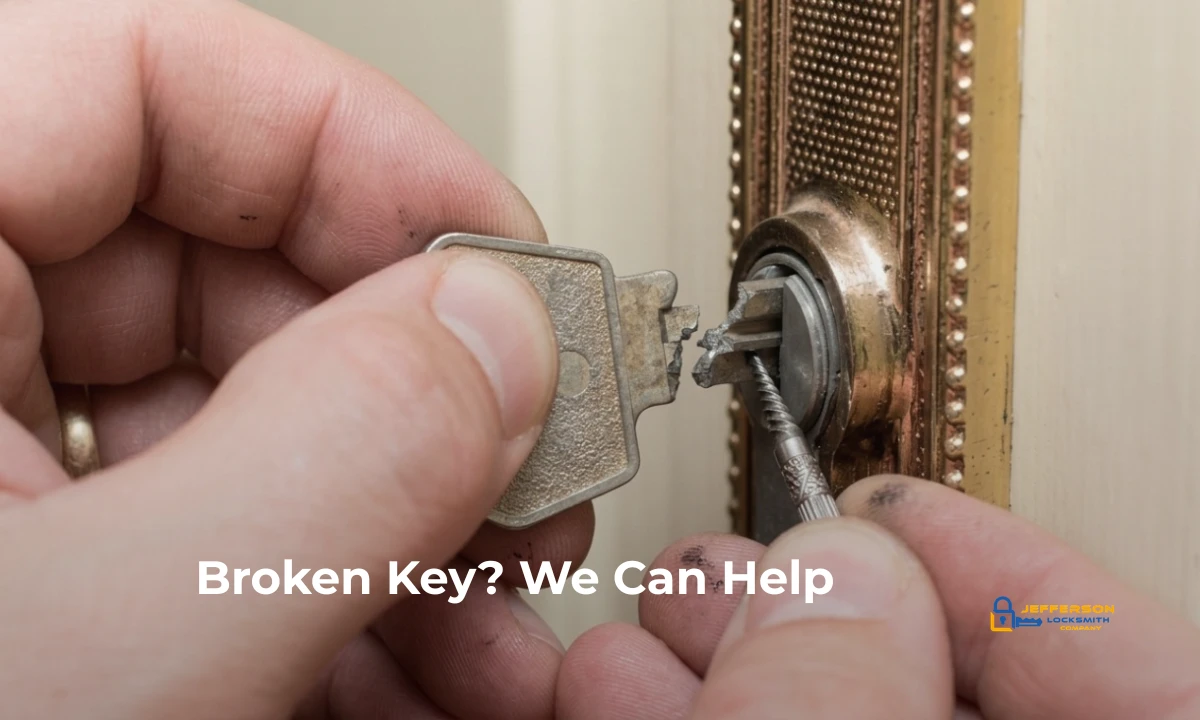
The most common mistake people make after a key breaks is immediately pushing something else into the keyhole. A screwdriver, a bobby pin, another key, any of these can drive the fragment deeper into the cylinder. What starts as a straightforward extraction job can quickly become a full cylinder replacement.
If at all possible, leave the lock exactly as it is and call us. Jefferson Locksmith operates Monday through Sunday, 6 AM to 11 PM. We send a mobile technician to your location, inspect the lock first, and explain exactly what needs to happen before any work begins. You make the call on whether to proceed. There is no obligation.
If the broken key also left you locked out of your home, our house lockout service handles both problems in a single visit. or other urgent lock and key situations during our service hours, our emergency locksmith service covers Philadelphia from 6 AM to 11 PM, seven days a week.
What Is Broken Key Extraction and How Does It Work?
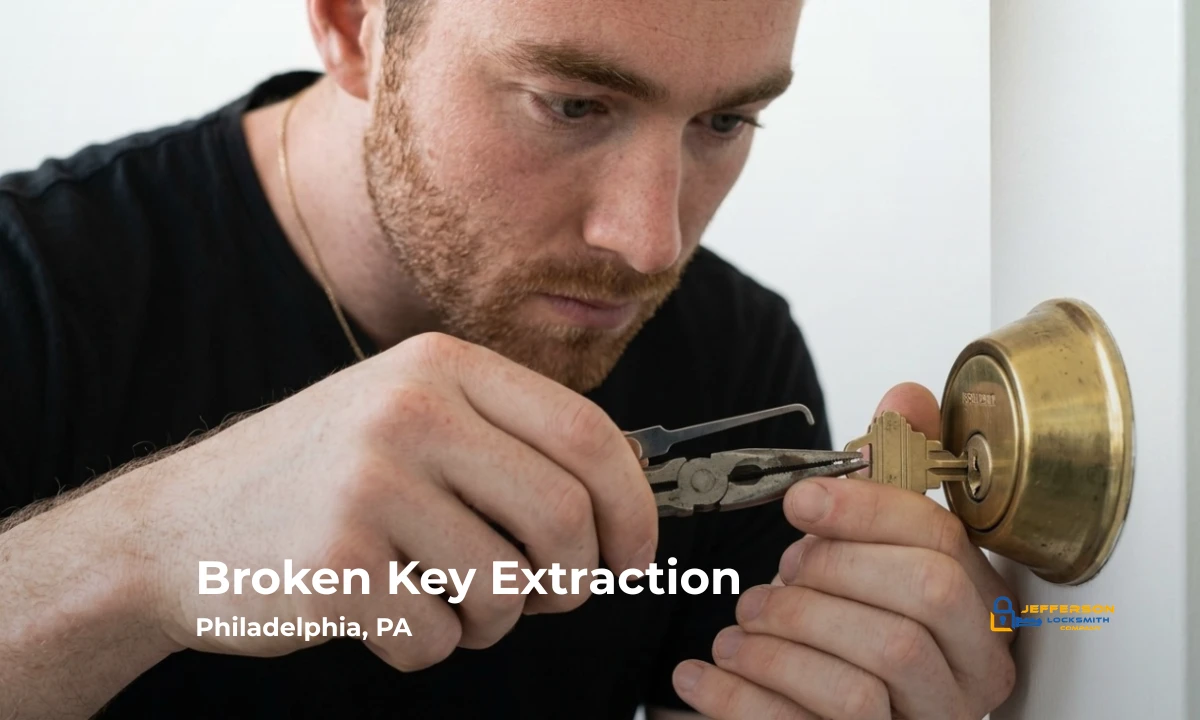
Professional broken key extraction takes 15 to 45 minutes on average. The technician uses specialized key extractors, tension wrenches, and precision instruments matched to the specific lock type. No hammering, no drilling, no guesswork.
Here is the process step by step.
- Assessment: The technician inspects the lock type, the depth of the fragment, and the position of the break inside the keyway. This determines which tools to use and whether the lock already has internal damage.
- Lubrication: A penetrating lubricant is applied to ease fragment movement without contaminating the cylinder.
- Extraction: A key extractor tool, a long, flat piece of metal with a slight hook at the tip, is inserted into the key profile and guided to the broken fragment. The hook catches the piece and draws it out cleanly.
- Lock function test: The cylinder is operated to confirm it works correctly and that no internal damage occurred during or before the extraction.
- Key replacement: If you need a new key, the technician can cut or duplicate one on-site so you walk away with full access restored.
DIY extraction attempts with household tools often push fragments deeper into the lock and can turn a simple extraction into a larger repair.
Broken Key Extraction for Homes, Cars, and Businesses in Philadelphia
The tools, the process, and the risks are not the same across every job. Here is how each scenario differs.
Residential Door Locks and Deadbolts
A key snapped off inside a deadbolt, door lock, or padlock can leave you unable to secure or enter your property. Precision extraction tools are designed to remove the broken piece without unnecessary damage to the lock or surrounding hardware.
This situation is particularly common in Philadelphia rowhouses where original lock hardware from the 1970s and 1980s is still in daily use. Along Ridge Avenue in Roxborough, through Germantown, Kensington, and across North and South Philadelphia, those original cylinders are aging.
Winter moisture works into the keyway and causes corrosion. A key that is already worn turns slightly harder every cold morning until it finally gives. We see these calls constantly, especially in January and February when temperatures drop overnight and locks have not warmed up yet.
We also handle broken keys in mailbox locks, cabinet locks, gate locks, and padlocks.
Our residential locksmith service covers broken key extraction alongside any related door hardware work in a single visit.
Car Locks and Ignition Cylinders
A key that breaks in a car ignition is a different situation entirely. The ignition cylinder is more complex than a door lock. The wafers inside are tighter, and damaging them during a clumsy extraction attempt can take a straightforward job and turn it into a steering column replacement.
There is also the practical reality of being stranded. You cannot drive the car to a shop. Calling a tow truck means paying tow rates plus shop rates, and potentially waiting several hours before anyone touches the ignition. A mobile locksmith who comes to you extracts the fragment on-site. In most cases, you are driving again without a tow involved. That can make a major difference when you are stranded and need the vehicle moving again.
Jefferson Locksmith dispatches mobile units across Philadelphia equipped to handle ignition extractions on the spot. We cover everything from the Schuylkill River waterfront to the SEPTA Regional Rail corridor through Manayunk and out toward Norristown.
Our automotive locksmith service covers ignition and door lock extractions citywide. If a broken key also means you need a new one cut or programmed, see our car key replacement service for same-visit options.
Commercial and Office Locks
A fragment jammed in a storefront lock on Main Street Manayunk or an office access system in Center City means downtime. It can also mean a security gap if the lock cannot fully engage. Quick, non-destructive extraction restores commercial locks without unnecessary delays, and without forcing a premature lock replacement.
Our commercial locksmith service handles extraction in mortise cylinders, rim locks, high-security cylinders, and office access hardware across Philadelphia.
Why Keys Break Inside Locks
Understanding the cause matters. It helps you prevent it from happening again, and it helps the technician diagnose whether the lock itself needs attention after the extraction.
Keys break due to metal fatigue from repeated use, excessive turning force, rust and corrosion buildup inside the keyway, foreign objects blocking the cylinder, or the brittleness that cold weather brings to both metal keys and lock hardware. A key that has been duplicated multiple times from a worn original gradually loses precision. It starts to bind slightly inside the cylinder. Every time you force it, the shaft weakens a little more.
Cold weather accelerates the problem. Metal contracts in low temperatures, making keys and cylinders more rigid and less forgiving of any misalignment. If you have noticed your key bending slightly, feeling loose, or your lock turning harder than usual, those are signs worth acting on before the key breaks entirely.
Using a key to pry open packages, scrape labels, or handle anything other than a lock damages the edges and weakens the shaft over time. Keys are precision-cut pieces of metal. They are not multi-tools.
For prevention: lubricate locks every six months with a silicone spray or graphite-based dry lubricant. Avoid WD-40 inside cylinders because it leaves residue that attracts grime over time. Replace worn keys before they break. If your cylinder is stiff in cold weather, a rekeying service or a lock repair visit is far less disruptive than an emergency extraction call at 7 AM in January.
What Not to Do When a Key Breaks in the Lock
This is worth covering directly because these are the actions that turn a recoverable situation into a damaged cylinder.
Do not use super glue: It bonds the fragment inside the keyway permanently and makes professional extraction significantly harder or impossible without destroying the cylinder.
Do not insert bobby pins or wire: These push the fragment deeper and can bend the pins inside the cylinder.
Do not force the remaining key stub: Pushing the broken half in to try to turn the lock drives both pieces further in and can crack the cylinder housing.
Do not try to turn the cylinder with a screwdriver or pliers: Torque applied incorrectly to a damaged cylinder causes internal damage that requires a full replacement.
Do not push the fragment further in: Leave the lock exactly as it is until the technician arrives.
Serving Philadelphia & Surrounding Areas
Fast locksmith response throughout the region—usually 20-30 minutes.
Bucks County
- Doylestown
- Bensalem
- Newtown
- Warminster
- Southampton
- + 12 more towns
How Jefferson Handles Broken Key Extraction Estimates
We do not quote prices over the phone. A broken key job has too many variables for that to be useful or accurate. The estimate depends on the type of lock involved, the depth and position of the fragment inside the cylinder, whether it is a residential door, a commercial storefront, a padlock, a mailbox, or a vehicle ignition. It also depends on whether the cylinder was already damaged before the key broke, and whether a new key needs to be cut or programmed at the same visit.
Every job starts with a free on-site inspection. The technician arrives, assesses the situation, and explains exactly what needs to be done and why. You receive a confirmed estimate before any work begins. If the scope is straightforward, that conversation takes a few minutes. If the lock needs repair or replacement beyond the extraction, that gets explained clearly before anything proceeds. You decide whether to move forward. There is no pressure and no obligation.
What happens after the key is removed?
The cylinder is tested to see if the key broke due to wear or lock failure. If applicable, key duplication, lock repair, or rekeying is recommended.
Why Philadelphia Residents Call Jefferson Locksmith for Broken Key Extraction
Jefferson Locksmith operates out of 128 Leverington Ave Suite 305, Philadelphia, PA 19127, in the heart of Manayunk. That puts us close to the neighborhoods that generate the most broken key calls: Roxborough, East Falls, Wissahickon, Chestnut Hill, and Mount Airy. We also cover the full city, from Fishtown and Northern Liberties through Center City, Rittenhouse Square, Old City, and Society Hill, down through Bella Vista, Passyunk Square, and across to University City, West Philadelphia, and Brewerytown.
Our technicians are licensed and insured. They carry specialized extraction tools for residential, commercial, and automotive lock types. Mobile units go directly to the job location so there is no towing, no drop-off, no waiting at a shop. Hours run Monday through Sunday, 6 AM to 11 PM.
After extraction, if a new key is needed immediately, we handle key duplication on-site. If the cylinder sustained damage and needs to be replaced, our lock installation service covers that in the same visit. The goal is to leave the job with the lock working and the customer with a key in hand.
Frequently Asked Questions
Can a locksmith remove a broken key without replacing the lock?
In the vast majority of cases, yes. Jefferson Locksmith’s technicians use specialized tools that remove the broken piece carefully while avoiding unnecessary damage to the lock mechanism whenever possible.
In rare cases where the lock was already damaged, the technician will recommend repair or replacement and explain why before any additional work begins. You will always know the full picture upfront.
How long does broken key extraction take?
Professional broken key extraction takes 15 to 45 minutes on average. Straightforward residential door lock extractions are often faster. Ignition extractions take longer due to cylinder complexity. The technician will give you a realistic time estimate on arrival after inspecting the lock.
How much does broken key extraction cost in Philadelphia?
The cost depends on the type of lock or ignition cylinder, how deep the fragment sits, whether the cylinder sustained prior damage, and whether a new key needs to be cut at the same visit. Jefferson Locksmith begins every job with a free on-site inspection. The technician provides a confirmed estimate before any work starts, and you decide whether to proceed.
My key broke off in the ignition and the car will not start. Do I need a tow truck?
Not if you call a mobile locksmith first. A tow truck can mean extra time, extra coordination, and a separate shop visit. A mobile locksmith comes to your location, extracts the fragment on-site, and in most cases has you driving again without any towing involved.
Jefferson Locksmith dispatches across Philadelphia with the tools needed to handle ignition extractions on the spot.
What should I do while waiting for the locksmith?
Stay calm. Keep any key fragment you recovered. Note whether the lock was in the locked or unlocked position when the key snapped. Do not insert any objects into the keyhole, and do not attempt to turn the cylinder with tools. Leave the lock exactly as it is. The less that happens before the technician arrives, the faster and cleaner the extraction will be.
Can you extract the broken key and cut a new one on the same visit?
Yes. After the extraction, the technician tests the lock to confirm it works correctly. If you need a replacement key cut or duplicated on-site, that happens immediately at the same visit. If you currently have only one key for that lock, getting a duplicate made at the same time is strongly recommended.
See our key duplication service for details on on-site key cutting options.
Why do keys break more often in winter in Philadelphia?
Cold weather contracts metal and makes both keys and cylinders more brittle. January and February in Philadelphia are the peak months for broken key calls, especially early in the morning when temperatures are at their lowest. This is particularly common in Manayunk, Roxborough, Germantown, and across the older rowhouse neighborhoods where 1970s and 1980s lock hardware is still in daily use.
Winter moisture works into the keyway over time and causes corrosion that makes the cylinder stiffer and the key more likely to snap.
If your lock has been hard to turn in cold weather, a rekeying or cylinder service visit before winter is far easier than an extraction call in February. See our lock rekeying page for more.
Prefer not to call?
Request a quote online
Fill out the form and we’ll get back to you as soon as possible, usually within a few minutes during business hours.
- Free estimates
- We respond directly
- Available Mon–Sun, 6 AM–11 PM
- Serving all Philadelphia
Did a key break? We'll remove it quickly without any damage
Careful On-Site Key Removal.
Open 6am – 11pm, 7 days a week. Serving Philadelphia and surrounding counties since 2017.